Tuesday, December 8, 2015

Conversion Tracking


Tracking a company website's conversion rate is very important. In this blog I am going to tell you how Weebly can help you gain an understanding of how to track conversions.

On Weebly, you can create a website and design it however you want. Weebly gives sample pictures and backgrounds, however you can add custom ones if you want or need to. For my background image I used a picture of a golf glove and a tee because I love to play golf. To track conversions on the Weebly website I made I created a contact form. The contact form allows someone to enter his or her first name, last name, e-mail, and any comments that they have. I was not using this as an actual website for something but just to learn how to track conversions. When people entered their name, number, e-mail, and comments, and then click submit, it would register as a conversion. When they click submit it would take them to a page that said thank you.

To track conversion rates and other important information such as bounce rate%, visits, and page views, I linked the Weebly site to google analytics. To do this, you must click admin in Google Analytics. This will all you to copy the name of your website and url so that everything can be tracked. Once you copy the website url and name, Google Analytics will give you a tracking ID to paste in the settings of your weebly account. The ID will allow all the site information to be transmitted to your Google Analytics account.


Thursday, December 3, 2015

A Guide to Choosing a Career Coach or Counselor

If you feel that you need some help with landing a job, a good idea may be to find a career coach or counselor. Boles' What Color is Your Parachute is a good guide to help you with your job hunt, but if you feel that it is not enough help, seek a career coach or counselor. There are people out there like this that are willing to help you find a job that best fits you. However, these career coaches or counselors often charge a fee because it is how they make their living. The fee is usually approximately $40 per hour in rural areas however it can be much more expensive in other areas. If that price is too expensive for you there is usually some type of free or almost-free help. This help is more likely to be in a group though instead of being face to face with an individual counselor.

So now that you know there are career coaches or counselors out there and how much they cost, the next step is figuring out how to go about finding a good career coach or counselor. The first step to finding a good career coach or counselor is to find three names of coaches or counselors that are located in your geographical area. There are a few ways that you can find these names. First, you can ask your friends or family if they have ever used a career coach or counselor. If they tell you that they have and that they liked them, then you should find out their names and how to get in touch with them. The second way to find names for a good career couch or counselor is by visiting by 312 of Boles' "What Color Is Your Parachute?" to see if there are any career coaches or counselors near you. Lastly, you can try a telephone book's Yellow Pages under headings such as: Aptitude and Employment Testing, Career and Vocational Counseling, Personnel Consultants, and if you are a woman, Women's Organizations and Services.

Once you find names, it is time to compare them and figure out what questions to ask them. Listed below are five questions that you should consider asking the counselors:

1. What is your program?
2. Who will be counseling? And how long has this person been counseling?
3. What is your success rate?
4. What is the cost of your services?
5. Is there a contract up front? If so, may I see it please, and take it home with me?


Tuesday, November 24, 2015

A Guide to Dealing with Your Feelings While Out of Work

In this blog post I'm going to give you a guide on how to deal with feelings and emotions if you are unemployed. You may be feeling sad, angry, and even have anxiety, but don't worry, it will soon pass. Your experience is not unusual. Everyone has been unemployed at one time or another and has felt weary or depressed. in Appendix B of What Color Is Your Parachute, Boles list ten things that you can do to deal with feelings when you are unemployed. I will describe these in detail below.

1. You can catch up on our sleep:
Catching up on your sleep is important because if you are short on sleep you will be more likely to be depressed. Your body is also going to feel run-down. Try to get to bed earlier at night or take naps during the day to catch up on your sleep. Just catching up on your sleep can often make us feel much better, so it is worth a try.          
2. You can stay physically fit:
According to job-hunters, there are a number of things that are important to stay physically fit. Some of these things are exercising regularly, drinking plenty of water, eliminate sugar from your diet, eat balanced meals, and take daily vitamins. Doing all or a majority of these things will help you feel better.
3. You can do something about the space around us:
According to Boles, our surroundings are mirror image of how we feel about ourselves. To keep a positive physical environment around you, keep things in order. Put your clothes away and keep things off your counters and table. If your surroundings are all messy you are more likely to become depressed.
4. You can go outdoors and take a good walk:
If you are sitting home all the time it could start to make you feel even worse. Take a wake outside and take in all the sunlight and natural environment around you. It will make you feel better.
5. You can focus on other people
If you have been dealing with unemployment for a long period of time you should consider dealing with people who are worse off than you. This will help you put things in perspective and give you a good feeling inside because you will be helping people who need it. This will also give you an opportunity to talk to others and meet new people
6. You can go on fun mini-adventures
In your area there may be places that you have not visited. For example if you live in a big city, go on a tour and experience something new. This will give you something fun to do and help take your mind off your job-hunt.
7. You can deal with your feelings by learning something new
If there are subjects that interest you but you have not explored them yet, now is the time to do it. Again, this will help you get your mind off of being sad or depressed and focus your attention on something you enjoy learning about. Read books or look online for article or videos that interest you.
8. You can talk with loved ones, or friends about your feelings
To help cope with your feelings, talk to loved ones or close friends. Often times these negative feelings can build up inside and over power us. To prevent this from happening, talk about these feelings with your family and friends. They love you and will be happy to listen to your feelings and help you sort them out.
9. You can pound a punching bad or pillows to get angry energy out
This may sound childish, but people do actually do this. It will help you take out anger without damaging anything of value around you.
10. You can make a list of the things that make you happy
By listing things we are thankful for, we will remind ourselves of the precious gifts we really do have in our lives. It is crucial to forgive ourselves for any past wrong doings. We all are human and we are all capable of facing the future rather than focusing on the the past.


Thursday, November 19, 2015

How to Start Your Own Business

In my last blog post, I gave you tips on how to choose or change your career. In this blog post, I am going to go in a different direction. Instead of giving tips on finding a career or changing a career, I am going to give you an idea to consider if your job-hunt isn't going well. Some people, have always wished that they could be their own boss because they do not like like working for someone else. If you are someone like this, you may want to consider looking into starting your own business.

When you have no idea what business you want to get int, there are four steps you should take. These four steps are:read, write, read, explore, get feedback.

WRITE

1.To begin with this step, you should reference back to chapter 7 which helps you understanding more fully who you are. You need to get an understanding of who you are and what you want to do.
2. Get out a piece of paper and write down some ideas. Use this page for any ideas that come to you as you complete the rest of the steps.
3. Write your resume, if you haven't already. Refer to chapter two if you need some help on writing your resume. When you are done writing it, read it over and see if anything gives you any ideas for a business of your own. It could even be something that you have done before for someone else.
4. If  nothing jumps out at you, try the following steps:

  • make another list of five things you love to do
  • make a third list of where the first two overlap
  • read your list, and ask yourself if anyone would pay you to do those things
5. If you are set on being your own boss, but are unsure of what business to go into, try visiting www.onetonline.org. Click occupations , then click career clusters to see if any clusters appeal to you. If any appeal to you, write them down on that piece of paper.


READ
Hopefully from everything I suggested thus far you will have some ideas on what type of business you would be interested in starting up on your own. The next thing you will want to do is read up on what it takes to run your own business. Some websites that will help you understand what it takes to start you own business are:

Take a look at these websites listed above and see what information will help you.


EXPLORE
Now, you most likely have some idea for starting your own business. However, as you probably already know, a lot of star-up companies don't make it. You do not want to become another one of those companies. To try to avoid this, interview others who have started a similar business. This will help you prevent making mistakes that they have made.

GET FEEDBACK
Now that you have information on what it takes to start a business on your own and have interviewed people who have already done the same thing, you need to think if you really want to do this. You need to find feedback. Ask people who are important in your life to see how they feel about what it is you want to do. You also need to see how much sacrifice a new business is going to take.

Starting a new business will take a lot of guts. If you are sure that you want to start up your own business, you need to keep three things in mind:

  • There is always some risk when you try something new. You should not try to avoid risks, but make sure that the possible risks are manageable.
  • Talk to others who have already done what you are thinking of doing. That will help you evaluate whether or not you still want to do it.
  • Have a back-up plan. Before you start, you need to know what you are going to do if your original plan doesn't work. 


Thursday, November 12, 2015

The Five Ways to Choose/Change Careers

In my last blog, I gave you tips to help you deal with any handicaps you may have. In this blog, I am going to describe four ways that can help you choose or change your career.

The First Way- The Internet
The popularity of laptops, tablets, and smartphones has given people ability to access the internet anywhere. Because these devices have become so popular, internet usage among Americans is very high. With that being said, the internet is the first place people will go to for guidance on to choose or change careers. There is a lot of advice on the internet, but more specifically there is a website called O*Net Online. This website is "a digital, online treasure house of information. On this site there are suggested careers that are grouped or classified by: industries in great demand, green economies, largest number of openings and anticipated, amount of preparation or training required, to name a few. Once you find an occupation you want to know more about, they have a special Content Model which has up to twelve pages of print outs for each occupation. 

Second Way-Tests
These tests are not actual "tests", they are instruments or assignments that be found in many places. Some places where these "tests" can be found are on the internet, in the offices of guidance counselors, or vocational psychologists, career coaches, etc. Often times, these tests turn out to be exactly the kind of guidance or direction that someone who is looking to choose or change their career may need. When looking at these tests, Boles gives six learnings: 1. you are unique, so only you can describe the "family" you belong to. 2. don't try to figure out ahead of time how you want the test to come out, stay loose and open to ideas. 3. when taking one of these tests, you should only be looking for clues or suggestions, rather than a definite answer that tells you what you must do with your life. 4. take several tests, not just one. One test can send you down the wrong path. 5. you are trying to broaden your horizons initially and later looking to narrow your options. Do not look to narrow your options right away. 6. tests will always have mixed reviews  

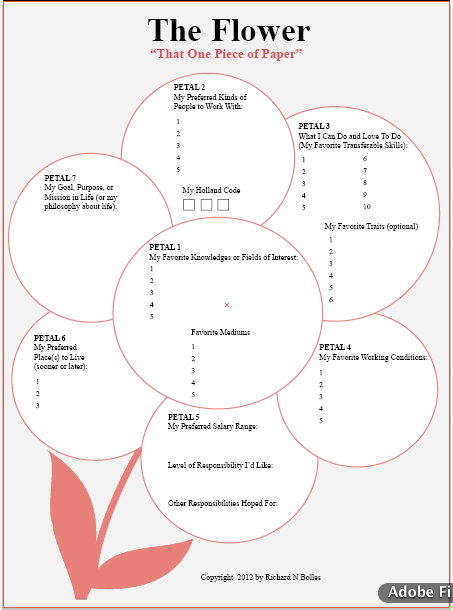
The Third Way- Using The Flower Exercise
When using the flower exercise, there are seven steps that may help you choose your career.
1. You have to do the flower exercise which will give you the building blocks of Who You Are so you can find what type of career is best for you.
2. Then put your five favorite transferable skills on a piece of paper, and three favorite fields of knowledge. This will help you find the names of careers that fit you.
3. If possible try to figure out a way to combine your three favorite fields in to one career to make yourself unique.
4. Talk to workers in the kind of careers you have picked out
5. Find out what kind of organizations in the area near you that interests you.
6. Look to find out the actual names of organizations that interest you, where you could do your best work.
7. Lastly learn about the places before you walk in and secure an appointment to talk to them about working there.

The Fourth Way- Finding Out What The Job-Market Will Need
You may have tried all of the previous ways to help you find or change a career, but none have worked. This last way is based on projections about the coming needs and wishes of the job-market. Instead of focusing on what you want, you will focus on what the job-market wants. There are a bunch of lists that describe "hot jobs", but take whatever you read with a grain of salt. Some of the hot jobs that Forbes.com listed were Software Developers, Accountant and Auditors, Market Research Analysts and Marketing Specialists, Computer Systems Analysts, Human Resources, Sales Reps, Mechanical Engineers, and Industrial Engineers. You can find more of these "hot jobs" online at www.bls.gov/ooh.


Tuesday, November 3, 2015

How To Deal with Any Handicaps You Have


Often times people may think that they are going to get turned down because of a "handicap" that they have or think they have. However you most likely don't have a handicap that will keep every employer from hiring you. No matter what handicap you actually have or think you have, it will not keep you from getting hired from any place in the world. The handicap would only keep you from getting hired at certain  places. It is your job to try to find employers that will want you, regardless of what others may think. To help you do this, I am going to give you a few tips based on the topics Boles covers in this chapter.

Do Not Generalize Employers
As mentioned earlier in the book, you should not generalize about employers. There will be employers that are interested in hiring for what you can do, but there will also be employers who are bothered by what you can do. No matter how many times you run into the latter and how frustrated you may be, you should always thank them and ask if they know any employers who may be interested in someone with your skills. In addition, you should should always remember to write and mail them a thank-you note no matter upset you may be. Then you must keep going day after day to find the employer who will only look at what you can do, not at what you can't.

Everyone Is Handicapped
You may be wondering how many people in the entire workforce is handicapped, and the answer is everyone. "A real handicap means disability: there are things that a person does not have the ability to do." There are approximately four thousand skills in the world, however the average person most likely only has one thousand of them. With that being said, there are approximately three thousand skills that every person does not have. The three thousand skills that people do not have will differ from person to person, but still everyone is "handicapped". So, when you go job-hunting you should focus your attention on what you can do instead of everything you can't do. If you have a real handicap, but it doesn't keep you from performing a particular job, than there's nothing special about it compared to other people's handicap.

What You Can Do, What You Can't
To focus on getting your mind off what you can't do, and on to what you can, take a piece of paper and divide it in to two columns. Then, do some research and get a list of skills that are transferable. Whatever list you find, copy as many of the skills on to the piece of paper, but put each skill into one of the columns. When you are done assigning the skills to one of the columns,pick out five favorite skills that you can do, and write how you actually used them in the past. This will help you gain an understanding of the the jobs you can do and love so you are able to hunt for them.


Tuesday, October 27, 2015

You Get to Choose Where You Work

To be able "to choose where you work", there are five steps that job hunters have found to be tremendously helpful

Step 1:You Need to Find Out What Careers or Jobs Your Flower Points To.
To find out what careers or jobs will best pursuit you, you will need take a look at a few of your best "expertises". Instead of choosing just one expertise, you should try to combine the three of them.  Combining more than one expertise will give you more career options. If you just chose one expertise you would be limited your options, making it harder for you to land a job. Once you have picked your top three "expertises" you should jot down everything that people may suggest to you. Whether you like the suggestions or not, it will help you with brainstorming.
 The following image will show a more in-depth flower that will help you find out what career or job that your flower may point to.


Step 2: You Need to Try On Careers Before You Decide Which Ones to Pursue
Like trying on clothing, jobs may not always look as good to you when you see them up close and personal. In order to find a job that is one that you would really like to do, you need to talk to people who are already doing that type of job.The LinkedIn website would be very helpful to finding people that do similar jobs to the one you may want. Once you are able to locate them, there a few questions that you should think about asking. These questions are: "How did you get into this work"?, "What do you like most about it?", and "What do you like least about?". These type of questions will give you a better idea of what that certain job requires and what people may like or dislike about it. If you do find out that you do not like what that job would offer, it may be helpful to then ask if they have any ideas as to who else you could talk to about your special interests and skills, and what type of careers use those skills.

Step 3: You Need to Find Out What Kinds of Organizations Have Such Jobs
Before you start thinking of certain business where you would want to work, it would be helpful to think of all kinds of places where one might get hired with the interest and skill set that you have. Thinking of every possible place will allow you to create a lot more options for yourself.  Every possible place would include the following places:

  • places that would employ you part-time
  • places that would employ temporary workers
  • places that would employ consultants
  • places that would employ volunteers
  • places that you could start up yourself


Step 4: You Need to Find Names of Particular Places That Interest You
When you are interviewing workers about their jobs or careers, someone may mention actual names or organizations that have certain kind of workers, and what's good or bad about the company.  This will be important for you when you start searching for jobs because it may give you some insight to places that you may want to work. The best way to find particular places that may interest you will be the yellow pages, LinkedIn, and search engines. For a successful job-hunt you should choose places on your interest in them, not based on open vacancies. Vacancies can open up at any instant so do not wait for them. To create a manageable number of targets you should make sure to not have too many names or too few names.

Step 5: You Need to Learn as Much as You Can About a Place Before Formally Approaching Them
Eventually, you will be able to find some careers that you would love to do. You have found these careers by interviewing people who do them and and researching names that offer them. The next step for you will be researching each place that offers the type of career you would love. You will want to know what kind of work they do, their style of working, their culture, what goals they are trying to achieve, and how your skills and knowledge can help them. You will be able to find this information by asking different people such as friends, neighbors, and people at the organization or in similar ones. This is important because it will give you a personal perspective of the company. You will also want to search the internet for this information and anything that you can find in print.